
Thursday, January 10, 2019
Math Talk Professional Learning
Today I facilitated a professional learning opportunity with about 10 teachers working with students grades kindergarten through 4th grade. It was a fun and busy day of learning with fabulous discussions. The content was developed utilizing online resources as well as content from Visible Learning for Mathematics (Hattie, Fisher, Frey), Talk Moves (Chapin, O'Connor, Anderson), and Number Talks (Parrish). The books are fabulous, and I would highly recommend a read. In the meantime, feel free to utilize some of the slides from these Google Slides I put together to help guide our work for the morning.


Sunday, January 6, 2019
Math Talk Moves Resource
This is a quick resource to help teachers remember five of the key math talk moves. The information on the bookmark is based on the information from the book, Talk Moves: A Teacher's Guide for Using Classroom Discussions in Math written by Chapin, O'Connor, and Anderson. It should be noted that there are other talk moves detailed in the book, this is just a resource for five that tend to be particularly high-leverage in my experience. See the PDF version of this resource here.


Saturday, January 5, 2019
SEL and Restorative/Holistic Discipline Notebook
So this is my prize possession as an administrator and something I wish I had spent the time to compile as a teacher-- my SEL/Restorative Discipline Notebook. Using the CASEL framework as a starting point I have taken an assortment of resources and put them into color-coded sections to be able to utilize in the moment when working with students around prosocial behaviors or restorative practices. Below is a brief explanation of what I keep in my binder to give you an idea of what works well for me. I am a big believer in 'making it your own' so this is really intended to give you a starting place to inspire you to create something fantastic that aligns with your school's SEL/PBIS work and is supportive of your students.
Binder Sections:

Binder Sections:
- Copies of Investigation Note Taking and Investigative Protocol
- Pink Tabs (Unrelated to CASEL): Community Resources, Apology Note Templates, Think Sheet Templates, School PBIS Expectation Lessons, and Community Service Menu copies.
- Orange Tabs (color-coded to correspond to CASEL): Self-Awareness Resources and Lessons, Self-Management Resources and Lessons
- Green Tabs (color-coded to correspond to CASEL): Social Awareness Resources and Lessons, Relationship Skills Resources and Lessons
- Yellow Tabs (color-coded to correspond to CASEL): Responsible Decision-Making Resources and Lessons
Some of the Resources I Used to Compile the Binder Content:
- School PBIS Lessons and Materials
- Kelso's and KC's Choice Wheel Materials
- Second Step (District Adopted Curriculum) Materials
- Kids Health Online Articles
- "What To Do When..." Series by Dawn Heubner
- Don't Suspend Me! An Alternative Discipline Toolkit by J. Hannigan

Friday, January 4, 2019
Edutopia Article: Dos and Don'ts of Classroom Decorations
There is such a fine line between classroom decorations that are engaging students in learning and classroom decorations that are distracting students from learning. I am loving this article from Edutopia that outlines some considerations for teachers as they set up their classroom environment. Based in researched best practices, this is a short read with some fabulous pointers!
Read Edutopia Article here.

Read Edutopia Article here.

Tuesday, January 1, 2019
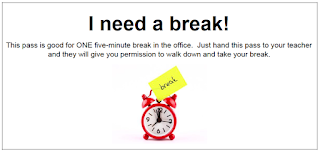
Break Cards
Break cards can be a helpful tool for students who have big reactions or escalations due to anxiety or work avoidance. It can give them an appropriate "out" before a big blow up and allow them a reflective or cool down moment before jumping into their work. For some students the break can be enough to reset them and get them ready for the task at hand, but often times break cards work best with additional interventions such as modifications to length, complexity, or intensity of classwork.

Behavior Contracts
Behavior contracts can be one way to address repeated, undesired behaviors in students. Below is a simple behavior contract format that can help students to recognize what prosocial behaviors they are working towards and which behaviors they are working to eliminate. I use this contract template during behavior conferences with the child, teacher, parents, and admin. It is helpful to bring all parties on board and make sure everyone is clear, consistent, and in agreement on what is expected from the student. View a full-size version of this behavior contract here.


Workshop Model and Small Group Differentiation
When working with teachers looking to better understand the workshop model and small group instruction, consider utilizing these two resources: Workshop Model and Management and Types of Small Groups. These documents can help to clarify the parts of workshop teaching and possible pitfalls to avoid as you plan.


Sunday, December 30, 2018
Community Service Menu
So this community service menu is something new I've been playing around with as a response to smaller disciplinary incidents. It is something that I heard about used at the middle and high school level and I wondered if it could be translated to an elementary school setting. I've used it only on rare occasion in all honesty, but it has really brought out the creativity of students who have offered to give back to the school by blowing up recess balls, helping re-teach younger students school rules, etc. Definitely something that I am looking forward to adjusting and making more meaningful as time goes on.


Don't Suspend Me! An Alternative Discipline Toolkit
Over the Winter break I took the time to order and read through a book that had been recommended to me called, Don't Suspend Me! An Alternative Discipline Toolkit. This is one that I would definitely recommend as well. It is a short read, but is filled with some great tools and templates for addressing discipline matters. The tools focus on three key areas: Restorative, Reflective, and Instructional practices to support students in learning from their behaviors. These practices, paired with proactive, PBIS-aligned classroom management strategies can be incredibly supportive of students and I am so excited to try some of them out!


Planning with Gradual Release of Responsibility (GRR) in Mind
When introducing GRR to new to the profession teachers it is important to help them to make connections to the content and lessons that they will be teaching. This GRR lesson planning template is one way that I have coached new teachers through lesson planning with GRR in mind. The template was created by me, but obviously based on the GRR work of Fisher and Frey. In my experience this tool is best used after direct teaching of the GRR framework and used collaboratively in partners or small groups of teachers to work through a lesson together before moving into independent use.


Investigative Protocols
When investigating a moderate or significant behavior concern that may warrant more in-depth action, it is important to have a clear protocol that all staff involved in the investigation follow. This ensures that all are on the same page and if questions arise about the integrity of the investigation it provides clear and consistent information on investigative measures. Below I would like to share two resources I developed (with input from some fabulous colleagues!) that I have found particularly useful when delving into investigations. First, a investigation protocol checklist that I used with my Dean of Students a couple of years ago to help us ensure we were approaching investigations similarly. Second, a investigation and interview template that I use with any investigation that I do. I keep a stack in my office and use these often when interviewing potential aggressors, witnesses, or victims.
Saturday, December 29, 2018
Family-Teacher Conferences
Conferences between families and the teachers can be an incredibly powerful experience, building authentic partnership with two-way communication between home and school that carries through the entire school year. A plethora of research suggests that strong connections such as these greatly benefit students and learning. This Harvard Family Research Project conference resource is one tool to help guide all stakeholders as conferences approach. Having a clear purpose for conferences and setting expectations for interactions can ensure that all voices are heard as goals and next steps for student achievement are determined.
The Three Big Ideas and Four Essential Questions
Richard DuFour's work around effective PLCs has identified three big ideas and four essential questions to help guide professional learning discussions to keep students, student needs, and student success at the forefront of PLC work. As teams delve into refining their collaboration, keeping these principles at the heart of the work ensures that students stay in the forefront. You can learn more about the three big ideas and the four essential questions of PLC work from this All Things PLC resource from Solution-Tree.
Creating Norms
Whether working with an established team of colleagues or just starting out as a PLC, it is crucial to establish clear norms for your time together. Patterns of behavior can quickly form and habits that derail or sabotage the work of your team (i.e. bird walks, complaining, discussion about nuts and bolts type items, etc.) can inadvertently come to the surface without thoughtful norms to hold each other accountable in place. As you create your norms as a team, consider utilizing a tool such as this Learning Forward Creating Norms protocol to help guide your decisions.
The Seven Stages of Professional Learning Teams
A first step in creating an effective PLC is taking time as a team to reflect on where your strengths and areas of growth around effective collaboration. A resource for this work is The Seven Stages of Professional Learning Teams rubric which outlines practices and potential next steps for teams as they dig into their work together. Periodically taking time throughout a school year to assess and reflect using this tool can help to ensure that your PLC members have a common vision and goals for their work together.
Thursday, August 21, 2014
Math Talk in the Classroom: Open Shares and Targeted Talk


Earlier this week, I was honored to facilitate some trainings in my district around math talk and formative assessment in the classroom. Above are the two resources that much of the information of the modules I presented was pulled from. I read both over the summer and they give powerful primary and intermediate vignettes, highlighting powerful math talk in classrooms. Because I was tasked with sharing information around math talk, the role of math talk in formative assessment and how these two work together to subsequently aid teachers in making sound instructional decisions in the classroom, I have been spending quite a bit of time thinking about my own math instruction. My realization this summer is that I have some place to grow and that is an exciting prospect. I am hoping to be a bit more effective and intentional when working with my students in mathematics. I am using open shares and targeted talk all the time in my classroom. Math talk is alive and happening everyday, but I don't know that I am as effective as I can be in utilizing that talk to assess my students understanding or misconceptions in math. In the past I have moved between open shares and targeted talk without always being cognizant of that formative assessment piece. Perhaps some of that just comes naturally as you teach and you aren't always fully aware of all of the "moves" you are making based off of the students responses, and in some ways that is probably okay. I do think this will be a goal for me as I enter the school year-- keeping that formative assessment in math talk in the forefront of my mind. Being aware of the decisions I am making and why. Becoming more precise, and intentional through the math talk occurring in my classroom and finding more effective ways of pinpointing next steps for my mathematicians in whole-group, small-group and partner work.
For those who may be interested. Here are some online resources that cover more on math talk, open sharing, targeted talk and formative assessment in math.
Wednesday, August 20, 2014
Teacher's College @ Columbia University
 \
\Teacher's College and the Summer Institute with Lucy Calkins: This link will give you more information on the institute I attended as well as the reading institute that is also offered. There are LOTS of other workshops and institutes as well, so make sure to explore a little.
Math Differentiation
Today was a fabulous day of professional development offered by my district around math instruction. So much great learning around differentiation, math talk and formative assessment influencing thoughtful math instruction in the classroom. As was absorbing lots of new ideas and thinking, I was reminded of a book I began utilizing really heavily last school year. The book I am thinking of is "Good Questions: Great Ways to Differentiate Math Instruction", written by Marian Small. This was recommended to me by a trusted colleague and I have to say it is my favorite resource in planning my math lessons. The focus of this book is on two easy to implement and extremely effective ways teachers can differentiate mathematics to meet the needs of their students in the classroom; through open questioning and through parallel tasks. The first chapter or two of this book defines open questioning and parallel tasks for the reader and also outlines how teachers might create their own questions and tasks that inherently differentiated for the needs of learners. If you look at the 2nd Edition, the final 3/4 or more of the book is aligned to the Common Core State Standards and gives both primary and intermediate examples of open questions and parallel tasks that can be used in the classroom.

What are open questions and parallel tasks? I need more information...
- Open Questioning: Open questioning is about asking broad questions that provide opportunities and access points for students at many developmental level to think about mathematics through a variety of approaches and responses.
- Parallel Tasks: Parallel Tasks are sets of related task that look at the same big idea, but are designed to meet the needs of students at differing developmental levels and that lend themselves to discussions around strategy and thinking.
- Additional Information and Resources:
Sunday, August 25, 2013
Planning: Creating a Curriculum Calendar/Map
So, this was my big project this summer to help me get my footing just a little bit into what first grade is really going to entail this school year. I worked with some of my colleagues from my previous school to piece together what reading, writing and phonics instruction would look like in a first grade classroom when focusing on the school year as a whole. We took into consideration CCSS, Benchmark Reading, Benchmark Writing and Lucy Calkins materials in order to comprehensively meet all of the rigorous learning expectations. I then took what we had done together with literacy and added in math, science, social studies, assessments and even what positive behavior qualities I also wanted to be sure to focus on throughout the year with my students. Linked is the (DRAFT) end product of that work. Very helpful for me to know I can fit this all into a year!
Again, I have linked my "finished" product as well as a blank template if other would like to try this themselves.
2013-2014 Curriculum Map/Calendar
Curriculum Map/Calendar Template
Again, I have linked my "finished" product as well as a blank template if other would like to try this themselves.
2013-2014 Curriculum Map/Calendar
Curriculum Map/Calendar Template
Friday, August 16, 2013
Welcome Postcards!
So, every year I try to send something to the students specifically to welcome them to the new school year. This is in addition to the introductory letter that I send to parents. The letter to parents highlights my experience, who I am and any important beginning of the year dates/events. The student letters are more of just a friendly hello. This year I found these cute postcards at The Children's Bookshop in Lynnwood, WA that I am going to send out. Again, I am not getting too specific in the message, just introducing myself and keeping the message about our new year together positive!


Subscribe to:
Posts (Atom)